Trust, but Verify by Asha Boardman
Oct 30, 2026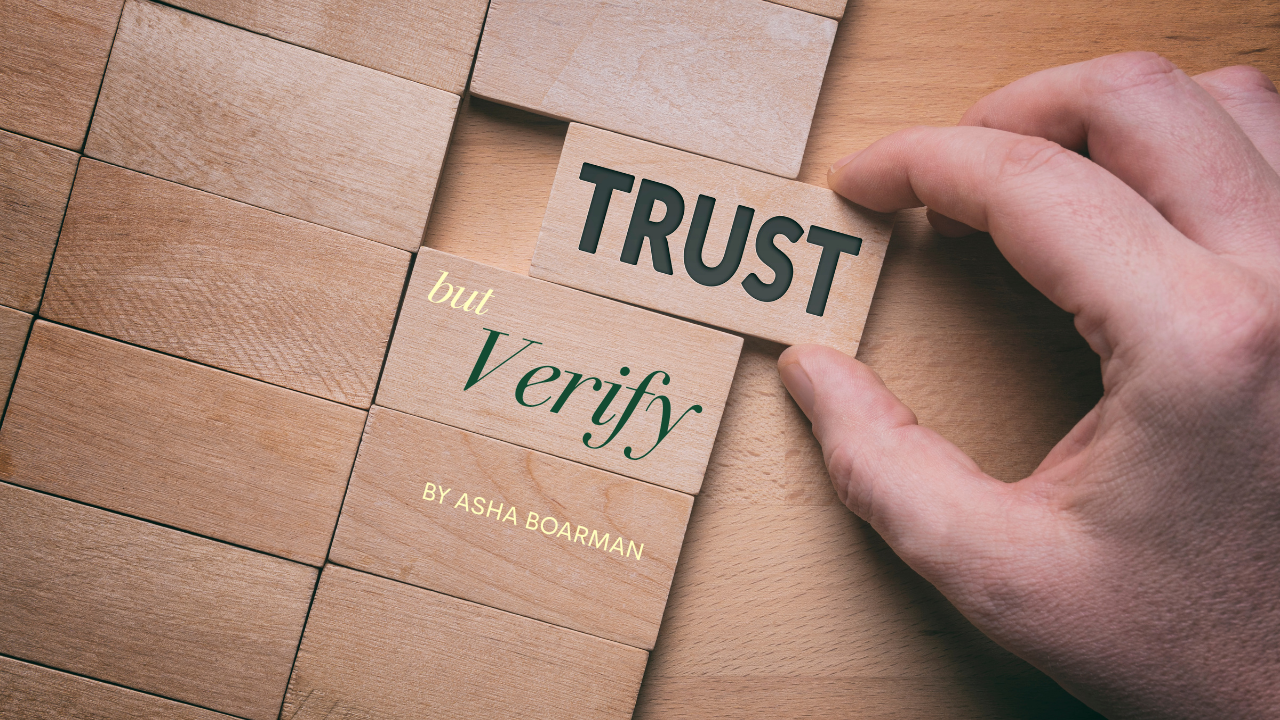
The balance between believing in people and being responsible for the outcome.
There’s a phrase I’ve heard throughout my career that has always stuck with me: “Trust, but verify.”
It sounds simple enough. But in leadership, relationships, and organizational culture, I think it deserves a little more thought.
Because trust is essential. And so is accountability.
I’ve spent a good portion of my career working with leaders, teams, and organizations, and one thing I’ve come to believe is that most people want to do a good job. They want to contribute. They want to be seen as capable, valued, and trustworthy.
So when something doesn’t get done, a deadline gets missed, or a commitment falls through, it can be tempting to jump to conclusions. We might question someone’s competence, commitment, or intentions.
But what if the issue isn’t a lack of trustworthiness? What if expectations weren’t clear? What if priorities shifted? What if someone needed support, direction, or a follow-up conversation they never received?
And, on the other hand, what if we trust someone so completely that we stop asking questions, checking progress, or confirming that the work is getting done?
Neither extreme serves us well.
Trust isn’t the absence of accountability.
One of the mistakes we can make as leaders is believing that checking on something communicates a lack of trust.
We think, If I really trust this person, I shouldn’t have to follow up.
But I would challenge that assumption.
Trust doesn’t mean we stop paying attention. It means we can pay attention without assuming the worst.
There is a meaningful difference between asking, “Did you get that done?” because we assume someone dropped the ball and asking, “How are we progressing on that?” because we care about the person, the commitment, and the outcome.
The first can feel like surveillance. The second can feel like partnership.
The difference often comes down to our posture, our communication, and the relationship we’ve built before the follow-up ever happens.
When expectations are clear and trust is established, verification becomes part of how we work together. It isn’t an accusation. It’s a healthy rhythm of communication.
Good intentions don’t replace good systems.
I’ve also learned that trusting people and building systems aren’t competing priorities.
We can believe in someone’s character and still create processes that help ensure important things don’t fall through the cracks.
We can empower a team member to own a project and still establish milestones along the way.
We can delegate responsibility without abandoning our responsibility as leaders.
And we can give people room to make decisions while maintaining visibility into the things that matter.
In fact, I would argue that good systems can actually strengthen trust. They remove the need to rely on memory, assumptions, and constant reminders. They create clarity around who’s responsible, what success looks like, and when we will check in.
This is especially important as organizations grow. What worked when a team consisted of three people may not work when it consists of thirty. A leader who once had visibility into every detail must learn to trust others, establish clear expectations, and build rhythms that keep everyone connected to the work.
The goal isn’t to control every outcome. It’s to create an environment where people can succeed without everything depending on one person remembering to ask the right question.
What are we actually verifying?
This is where I think leaders need to be especially intentional.
Are we verifying that someone followed our preferred process, or that the desired outcome was achieved?
Are we checking progress because the work genuinely requires it, or because we struggle to let go?
Are we asking questions to understand, or to confirm what we already suspect?
Those distinctions matter.
Sometimes our need to verify has more to do with our own discomfort than with the person we’re leading. We may have been disappointed before. We may have a hard time delegating. We may believe that if we aren’t personally involved in every detail, something will go wrong.
That is worth examining.
Healthy accountability should create greater ownership, not greater dependence. If people feel they need permission for every decision or fear being questioned at every turn, we may have built a culture of compliance rather than one of trust.
But the opposite is true, too. If people are given responsibility without clear expectations, meaningful feedback, or follow-through, we haven’t empowered them very well. We’ve simply left them to figure it out.
Leadership requires us to find the balance.
Trust is built in both directions.
We often talk about whether leaders trust their teams. But trust is reciprocal.
Do our team members trust us to communicate expectations clearly? To follow through on our commitments? To give honest feedback? To address a concern directly rather than allowing frustration to build behind the scenes?
Do they trust that when we ask for an update, we’re looking for information rather than an opportunity to criticize?
And do we trust them enough to hear an honest answer, even when the answer isn’t what we hoped to hear?
A missed deadline doesn’t automatically mean someone is unreliable. But how we respond to the missed deadline, and what happens next, can tell us a great deal.
Do we acknowledge it, understand what happened, clarify expectations, and make a plan?
Or do we ignore it because the conversation feels uncomfortable, only to become resentful when it happens again?
Trust doesn’t require us to overlook patterns. It asks us to address them honestly and fairly.
We can extend grace without eliminating consequences. We can assume positive intent while still expecting people to take responsibility. And we can care deeply about someone while having a difficult conversation with them.
In my experience, those things aren’t contradictory. They are often what healthy relationships require.
A little reflection for leaders
The next time you’re tempted to say, “I trust them, so I don’t need to check,” or, “I can’t trust anyone to get this done,” pause for a moment.
Consider a few questions:
-
Have I clearly communicated what success looks like?
-
Have we agreed on ownership, timing, and how we’ll communicate progress?
-
Am I following up to support the outcome or to manage my own anxiety?
-
Have I created an environment where someone can tell me the truth, even when things aren’t going well?
-
If a commitment wasn’t met, have I addressed it directly and fairly?
Sometimes the answer will reveal a gap in our systems. Sometimes it will reveal a gap in communication. And sometimes it will reveal a pattern that needs to be addressed.
The point isn’t to eliminate uncertainty. It’s to respond to it with wisdom rather than assumptions.
The balance is the leadership.
I believe the best leaders hold two things together: a genuine belief in people and a genuine commitment to the work.
We don’t have to choose between being trusting and being responsible. We don’t have to micromanage to maintain accountability, and we don’t have to avoid accountability to demonstrate trust.
We can give people the benefit of the doubt and still ask the follow-up question.
We can celebrate their strengths and still address an area for growth.
We can extend trust while putting the right checkpoints in place.
And we can remember that verification isn’t necessarily about catching someone doing something wrong. At its best, it’s about making sure we’re aligned, keeping our commitments, and helping one another succeed.
Perhaps the real question isn’t whether we trust people enough to verify.
Perhaps it’s whether we’ve built the kind of culture where trust and accountability reinforce one another rather than compete.
Because trust creates the foundation for meaningful work. Clear expectations give that work direction. And accountability helps us follow through on what we’ve committed to do.
Trust, but verify.
Not because we expect the worst in people, but because we care enough about the people, the relationships, and the mission to make sure we’re getting it right.
— Asha Boardman
Hi!